
I got annoyed by the Paris Olympics arguments over gender and blogged about it in October, (https://lindykato.com/2024/10/01/gender-id/ ) but I have been wound up again because I found out gender assignment at birth can still be carried out in New Zealand.
Bunnies (see later) I had to insert the bunnies because facebook doesn’t like pictures that could be erotic.
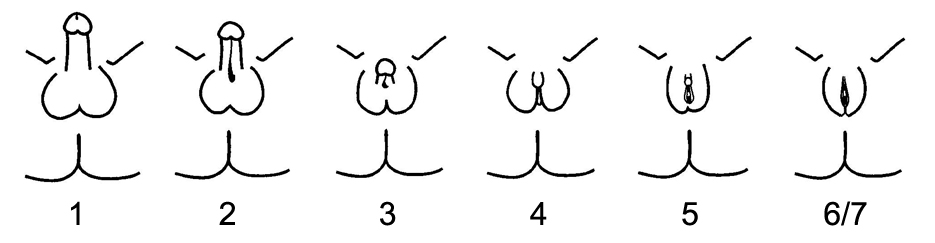
https://commons.wikimedia.org/wiki/File:Quigley_scale_for_androgen_insensitivity_syndrome.jpg The picture is drawn by Jonathan Marcus (2010) and shows degrees of androgen insensitivity.
According to the recent census 15,039 people stated that they know they were born with a variation of sex characteristics. Amnesty international reckon an average 1.7% of the population is born with intersex variations which means that either the population of New Zealand is unusual (which is well known since we punch above our weight in just about everything) or 69,961 people living here don’t know or won’t say in the census (which I can understand).
I have heard people say that gender is basic biology. Slightly advanced biology will demonstrate that it simply can’t be so simple. I already wrote in October how complicated sex was, I didn’t mention how many ways a baby can look ambiguous down below.
Sex generally refers to chromosomes and genitalia. Gender refers to psychosocial identity which is again more complex than male / female / ambivalent. Sexual orientation is another layer regarding how you feel. The common view for more than a thousand years was that women were men that had failed to develop. In fact, female is the default. It is important to note that being in possession of a Y chromosome doesn’t reliably make you male. If the tip is broken off (the sex determining factor) then you will be female, if you have testosterone insensitivity then you will be female even with an intact Y chromosome. Another rare genetic condition is a deficiency in the enzyme 5-α-reductase. Babies are apparently female at birth but grow a functioning penis at puberty. Although this condition occurs elsewhere in the world, in the southwest of the Dominican Republic these boys are called Guevedoces (which literally translates into ‘penis at 12’).
A recent Wikipedia search (page last edited 29th November 2024) https://en.wikipedia.org/wiki/Disorders_of_sex_development listed thirty-two known disorders of sexual development. Widespread genetic testing (AncestryDNA, 23andMe etc.,) has revealed that many of us live with genetic anomalies — not only extra or missing chromosomes, but whole chunks of chromosome getting deleted, chunks duplicated, chunks stuck onto a different chromosome altogether, mutations that should be deadly but that show up in the healthy adult simply trying to find where they came from. I suspect therefore that there are many more ways that sexual development can be different than are known.
Almost always there is no urgency, or need, to correct genitals and because of a belief that it is easier in younger children, it is usually done before the age of five when children cannot provide informed consent. We aren’t talking about gender reassignment instigated by the child here, we are talking about babies, whose bits don’t fit social norms.
You can put the foetal testis of a male rabbit into a female rabbit foetus, and it will develop into a male. Conversely if you prevent hormonal expression of the testis in a male bunny foetus, then the default is a female bunny. No one asked the rabbit how it felt, only the resultant genitalia are taken into consideration. It transpires that human development can be similarly messed with in terms of hormonal programming. But it doesn’t make it right!
That no one asked the bunnies how they felt is important. In 1966 (US), following a botched circumcision, Bruce Reimer (later Brenda), was the poster child for changing a boy into a girl by penis removal and hormonal treatment. However, Bruce (Brenda at the time) didn’t see it that way and despite oestrogen (s)he refused to complete the gender reassignment at age 15 and threatened suicide. She changed her name to David and made sure it was known that the experiment hadn’t worked. Ultimately the event was even more tragic because Bruce / Brenda / David had a twin brother (Brian). Brian committed suicide at the age of 36 over his treatment of Brenda whom he would exclude when she wanted to play with his friends and boy type toys. David shot himself in the head, aged 38.
Although the 2020 amendment of the 1961 NZ crimes act made genital mutilation illegal, it specifically still allows for sexual reassignment surgery “for the benefit of that person’s physical or mental health”. The problem comes when surgery is carried out without the consent of the patient.
Conservatively some 15,000 gender reassignments have been carried out on babies worldwide sometimes for problems with the waste system rather than the reproductive system. Sophie Ottaway (UK) was born a boy in 1986 with abdominal defects which included a bladder in two parts outside of his body and a split penis. He had perfectly functioning testes removed at two days old and a vaginal reconstruction. Sophie found out accidentally, aged twenty-two and, in her words, fucking exploded. Her chances of a family taken away without her consent (J. Calkin 2023).
There have been cases of identical twins, without penis trauma where one twin does not believe they are in the right body, so clearly there is more than genetics involved. My own PhD research taught me that genetics is much more complicated than commonly believed and the expression of genes (on, off, how much, etc) can be controlled by other parts of the genome, i.e. short bits of copied DNA that don’t code for a protein but influence other genetic expression (known as small noncoding RNAs) and also influenced by diet and environmental factors as well.
An increase in environmental endocrine (hormone) disruptors is likely to have resulted in the increase in gender identity issues around the world. The sex chromosomes do not directly determine gender identity or sexual orientation but influence the secretion of various hormones. It is thought that androgen exposure correlates with sexual expression, but we thought that we knew it all before, so I am not prepared to say anything about it. I just think New Zealand should be leading by example rather than lagging.
Calkin, J. (2023) A Boy Named Sophie. North and South, Telegraph Media Group


 Lindy Kato (Writer)

Please leave a comment, I totally value feedback!