
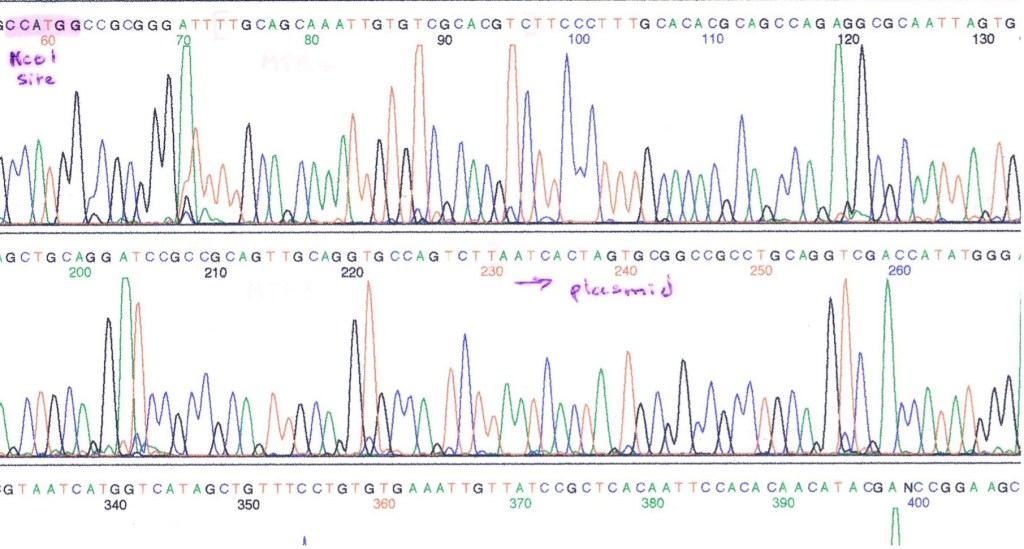
The sequencing diagram is part of my own small claim to fame.
Last year the National Health System (NHS) in England announced they aim to screen the entire genetic code of newborn babies for diagnosis and treatment of more than 200 rare diseases. It’s called the Generation Study the aim is for 100,000 newborns to be tested. The website states the 200+ genes will be tested (and lists them – this list will quickly grow). They cannot guarantee to keep the data from being accessed and there is a warning on the website but I don’t think it’s enough. Parents should be aware that this is research and in the scientific communities own interest rather than yours and I’ll give you some reasons why. This is an additional warning buried on the website.
Your baby could get an incorrect result. This study is for research and is not a diagnosis. This means there is a small chance we could get your baby’s result wrong.
Of course a baby can’t give consent. There goes their opportunities as a career criminal. I don’t doubt that in the future the police will use it not only to catch a criminal but find familial matches for relatives not on the data base. I’ll have to blog about the rapist with the shoe fetish another time (the first as far as I am aware to be found via searching for familial DNA). You can’t tell me this DNA sequence will be destroyed, it’s far too valuable.
Currently the heel prick, or Guthrie test, tests for nine disorders in the UK. The test was developed by Robert Guthrie, a microbiologist with a niece with Phenylketonuria, or PKU. Untreated PKU causes severe intellectual developmental problems in children. The earlier test involved pressing a strip of paper soaked in ferric chloride onto a wet nappy – it would turn dark blue/green in response to phenylpyruvic acid builds up in cases where the enzyme needed to break down phenylalanine (an amino acid) isn’t working properly. The test was tricky to do and didn’t always work so Guthrie developed the blood spot test that only needed a tiny drop of blood and the technique has since been coopted to cover many more tests.
The treatment for PKU is a restrictive diet from birth because once the brain damage from the build-up of phenylpyruvic acid has occurred it can’t be reversed. This is why there is a warning on diet drinks caution phenylketonurics contains phenylalanine which is used in the artificial sugar Aspartame.
It hadn’t occurred to me that the New Zealand Guthrie test would be different from the UK test but it is. Sickle Cell anaemia is not included in the New Zealand test. It is rare in Australasia so I get that. Biotinidase deficiency occurs in roughly one New Zealand baby every three years, so rare as well but tested in New Zealand and yet not in the UK.
The reason it isn’t tested in the UK is because it is unknown how common biotinidase deficiency is in the UK. I need to explain here – if it is mild there may be no symptoms, however if it is severe it can cause muscle weakness, seizures, developmental delay, hearing loss and so on and is easily treated by taking biotin. The NHS argues that some babies will be given biotin who do not necessarily need it if their symptoms turn out to be mild. If there are a large number of mildly affected people already in the UK this could end up being a lot of babies. Plus the test throws up a wide range of results not always indicative of a problem.
This is a tricky topic. Cystic fibrosis is a relatively common rare disease tested via the Guthrie test in both countries but it misses some cases because only the common mutations are tested for. There are 700 known mutations and some may be mild and some serious.
This brings me to another problem. Although we are taught in school that one gene can lead to a disease, in practice this is very rare. In part testing outfits such as 23andme, and Ancestry DNA etc., have found that mutants walk amongst us. My PhD supervisor reckoned everyone had at least five mutations but now I think that was a woeful underestimate. People/parents only seek out DNA testing because there is already a problem, usually unsolved. This skews the data bases when a mutation is found and ascribed to that condition without sufficient information because the testing of healthy people is inadequate. Mind you, testing 100,000 babies might help with that.
I can think of two examples without much trouble, and there will be many more. A rare form of diabetes is caused by a variation in the HNF4A gene. This gene codes for a factor that switches other genes on and off, so a control switch if you like. It was discovered because the rare type of diabetes (overproduction of insulin) presents in babies often within the first month of life and runs in families. In those families the odds of having this condition are high. The thing is that there are plenty of people walking around with the same mutation and are perfectly healthy. This indicates that they have some kind of genetic makeup protecting them that is currently unknown. You will find, and possibly test/treat or otherwise disrupt the life of a newborn for a disorder they don’t have.
Another is Ogden syndrome (so named because the family came from Ogden in Utah, famous for their genealogy collection), and ascribed to a mutation in the gene NAA10 which is on the X chromosome and so affects mostly boys – because girls (having two X chromosomes) are generally saved from X chromosome mutation defects by the spare. Which is another interesting thing because the spare X chromosomes is supposed to be scrunched up into a Barre body and not utilised. However it turns out that there are Barre body escapees (don’t get me started). The Ogden boys died in infancy from many anomalies but with recognisable facial features. Then another family in California was shown with the same mutation so it was declared that NAA10 was the gene for the Ogden issue and renamed NAA10 related syndrome. The thing is a lot of these were girls and didn’t die in infancy and were variably affected – so something else is going on. This is my point, the idea of a ‘gene for’ in a Mendelian ideal, doesn’t exist and if it does then it is the outlier not the common situation.
Another instance where babies may be unnecessarily investigated, and let’s not forget the disruption to families of hospital appointments (they aren’t only testing rich people’s babies), is mosaicism. This is likely not on the tip of the tongue for the parents of newborns but is where some cells have a mutation and some do not.
Mutations can happen in a single cell early in embryonic development and lead to genetic changes not present in a parent’s egg or sperm cells, or in the fertilised egg, but later when the embryo includes several cells. As the cells divide during development, cells arising from the altered cell will carry the mutation, while other cells will not. Depending on the mutation and how many cells are affected, mosaicism may or may not cause health problems.
This complicates testing because already well described problems such as Downes syndrome can be evident in some cells and not in others and so what to tell parents? “Your child may or may not be affected and honestly – we might have worried you over nothing.” Would it be worth the anxiety that such a diagnosis could provoke?
By all means get your child sequenced, and I applaud that some children will benefit from early diagnosis and treatment, but understand this is research not medicine.


 Lindy Kato (Writer)
Please leave a comment, I totally value feedback!